
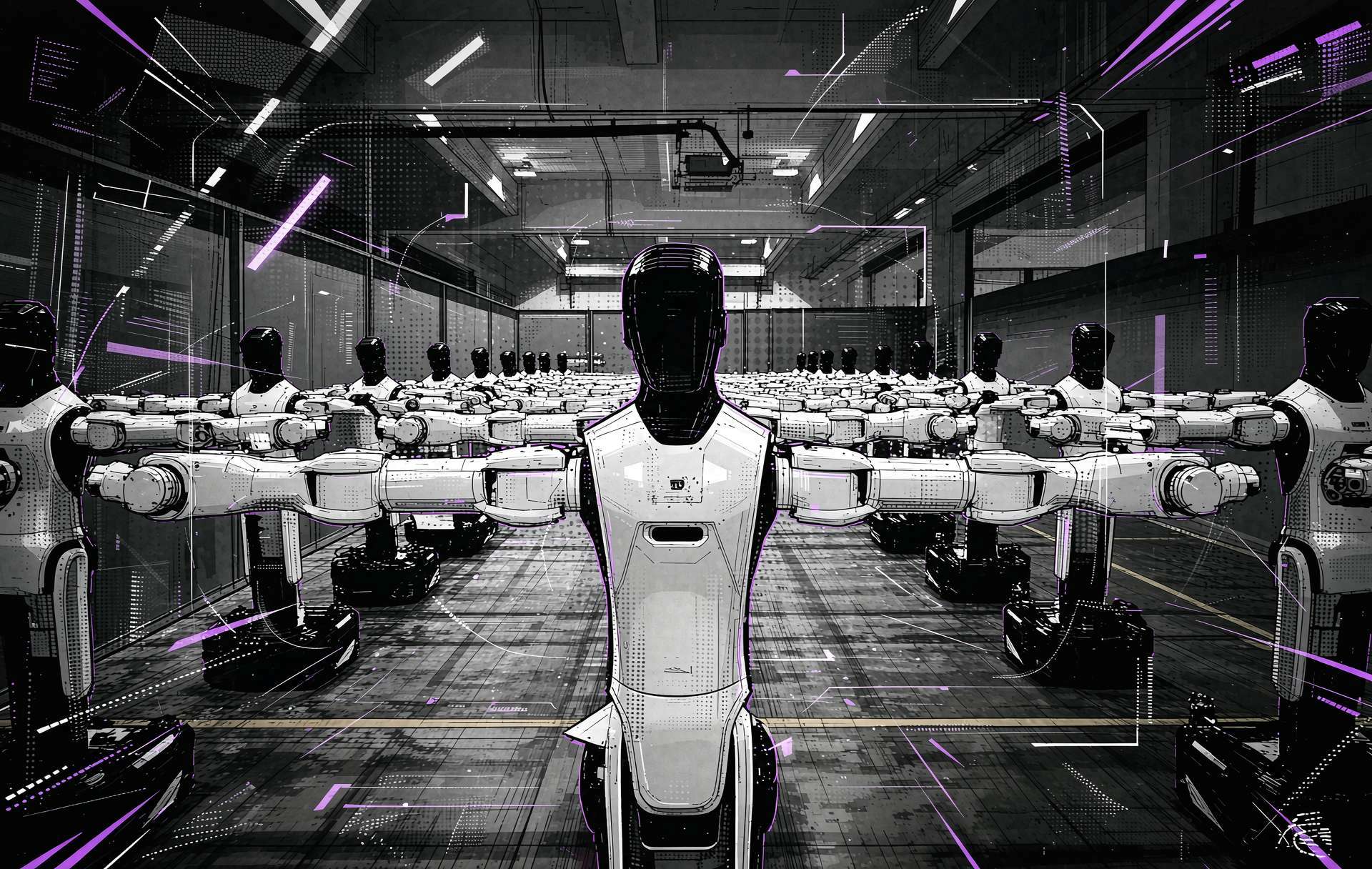
人形机器人被视为继计算机、智能手机、新能源汽车之后的又一种颠覆性产品。在中国科学院、工业和信息化部、北京市政府的支持下,中国科学院自动化研究所人形机器人攻关团队自主研制了人形机器人设计组装大工厂,可自动完成人形机器人硬件AI设计方案和软件算法的选择,并在高精度环境下进行快速验证,大幅缩短现有研发周期。
Humanoid robots are regarded as another disruptive product after computers, smartphones, and new energy vehicles. With the support of the Chinese Academy of Sciences, the Ministry of Industry and Information Technology, and the Beijing municipal government, the humanoid robot research team at the Institute of Automation of the Chinese Academy of Sciences has independently developed a humanoid robot design and assembly mega-factory, which can automatically complete the selection of humanoid robot hardware AI design solutions and software algorithms, and conduct rapid verification in a high-precision environment, greatly shortening the existing R&D cycle.
人类只需提供需求场景和任务
中国科学院自动化所高级工程师陈萌介绍,人形机器人大工厂就是通过AI的方式,让AI来帮我们人类去设计我们需要的机器人,我们人类只需要提供我们需要的需求场景和任务就可以了。记者在演示现场提出了室外场景可能需要速度更快或稳定性更高的要求。陈萌说,我们人为地去调整一下它的速度,但是调整之后,它的稳定性、精度包括一些材料等级等参数,会根据我这一个速度产生相应的约束性的变化,能够让机器人成为一个更合理的形态。同时,我们选的这些执行器一体化关节,包括上面的机器结构的一些材料,都会根据我们提的一些性能的设计需求来自动匹配。记者看到,根据室外需求达到速度更快的一个机器人,初步模型大概几十秒就出来了。
Humans only need to provide the demand scenario and task
Chen Meng, a senior engineer at the Institute of Automation of the Chinese Academy of Sciences, introduced that the humanoid robot mega-factory uses AI to let AI help us humans design the robots we need. We humans only need to provide the demand scenarios and tasks we need. At the demonstration site, a reporter raised the requirement that outdoor scenarios might need faster speed or higher stability. Chen Meng said, "We manually adjust its speed a bit, but after the adjustment, its stability, precision, and some material grade and other parameters will produce corresponding restrictive changes according to this speed, enabling the robot to become a more reasonable form. At the same time, the integrated actuators and joints we select, including some of the materials of the mechanical structure on it, will automatically match according to the performance design requirements we raise." The reporter saw that for a robot achieving faster speed according to outdoor requirements, the preliminary model came out in about dozens of seconds.
硬件和软件同时进行
中国科学院院士、多模态人工智能系统全国重点实验室乔红说,人形机器人非常复杂,整个系统大概有40个关节,其次因为它是通用的,所以它可能在不同的环境都需要。我们的工作里面是把硬件和软件同时进行,我们可以去设计人形机器人的硬件和它的相关的比如说感知、决策、控制这些算法,然后在软件里面做验证,保证在不同的结构下不同的性能下,我们都能够迅猛地去设计做好,这样加快了迭代的速度和稳定性,原来可能比如说半年的工作,现在可能半个月就能做好。
Hardware and software proceed simultaneously
Qiao Hong, an academician of the Chinese Academy of Sciences and of the National Key Laboratory of Multimodal Artificial Intelligence Systems, said that humanoid robots are very complex, with the entire system having about 40 joints, and secondly, because they are general-purpose, they may be needed in different environments. "In our work, we proceed with hardware and software simultaneously. We can design the humanoid robot's hardware and its related algorithms, such as perception, decision-making, and control, and then verify them in software, ensuring that under different structures and different performance levels, we can design and complete them rapidly and well. This accelerates the speed of iteration and stability. What originally might have taken, say, half a year of work can now be done in perhaps half a month."
Q4类脑智能机器人
在机器人实验室里,科研人员展示了他们心目中未来的人形机器人——Q4类脑智能机器人。从神经环路到肌肉激活,它都能模拟人的机制、结构和功能,实现高柔顺、高精度运动。陈萌说,它是完全仿人的,是一个由内而外的设计思路,其他的像Q1到Q3,是一种信息化、电子化的设计,这个完全是生物学的人类这样的设计理念。从硬件上来说,我们是完全按照人体肌肉骨骼分布的情况,去设计整个的驱动系统,像这些腱绳就是仿照我们人的肌肉,这些结构的地方就是仿制我们人的骨骼。在一条单臂上,我们设置了15个驱动模块,和人体的肌肉分布是完全相同的。我们仿制了脑区不同的网络,这些网络已经被我们验证过,它是可以像人一样,去做脑区放电的动作指令。
Q4 brain-inspired intelligent robot
In the robotics laboratory, researchers showed the humanoid robot of the future in their minds—the Q4 brain-inspired intelligent robot. From neural circuits to muscle activation, it can simulate human mechanisms, structures, and functions, achieving highly compliant and high-precision movement. Chen Meng said, "It is completely human-like, a design approach from the inside out. Others, such as Q1 to Q3, are informational and electronic designs, while this completely follows a biological human design concept. In terms of hardware, we designed the entire drive system completely according to the distribution of human muscles and bones. These tendon ropes imitate our human muscles, and these structural parts imitate our human bones. On a single arm, we set up 15 drive modules, completely identical to the distribution of human muscles. We imitated different networks of brain regions, and these networks have been verified by us to be able to perform discharge action commands in brain regions like humans."
走向应用需要过三道关
人形机器人要从实验室研发走向广泛应用,需要达到高性能、低成本、批量化三个要求。专家介绍,如何让具有40多个自由度、平均体积与人相当的复杂人形机器人系统精准完成各类任务,同时将整机成本控制在25万元以内,是一个重要挑战。乔红说,为了高性能和低成本,我们还组织了专门的零部件研发小组,怎么样用我们国产的零部件替换国外的一些零部件,这样能够把成本进一步降低。第二个部分就是更重要的部分,它到不同的家庭或者到不同的工厂,能不能稳定工作变成一个最关键的核心的部分。一个是价格的敏感性,一个是稳定性的敏感性,我们能不能用软件的方式和硬件的方式结合起来,使得整个系统是高性能、低成本和高稳定的。中国科学院自动化所副研究员陆浩判断,大模型会和人形机器人相结合的这个产品,一到两年内会有非常多的示范应用在各个领域,包括家庭服务、娱乐、科研、制造等领域,未来三到五年可能会真的落到大众的生活里边去。
Moving toward application requires passing three hurdles
For humanoid robots to move from laboratory R&D to widespread application, they need to meet three requirements: high performance, low cost, and mass production. Experts introduced that how to enable a complex humanoid robot system with more than 40 degrees of freedom and an average volume comparable to a human to accurately complete various tasks, while controlling the complete machine cost within 250,000 yuan, is an important challenge. Qiao Hong said, "For high performance and low cost, we have also organized a special components R&D team to see how to replace some foreign components with our domestically produced components, so as to further reduce costs. The second part is the more important part: whether it can work stably when it goes to different homes or different factories becomes the most critical core part. One is price sensitivity, and the other is stability sensitivity. Can we combine software and hardware approaches to make the entire system high-performance, low-cost, and highly stable?" Lu Hao, an associate researcher at the Institute of Automation of the Chinese Academy of Sciences, judges that products combining large models with humanoid robots will have many demonstration applications in various fields within one to two years, including home services, entertainment, scientific research, and manufacturing, and may truly enter the lives of the general public in the next three to five years.