
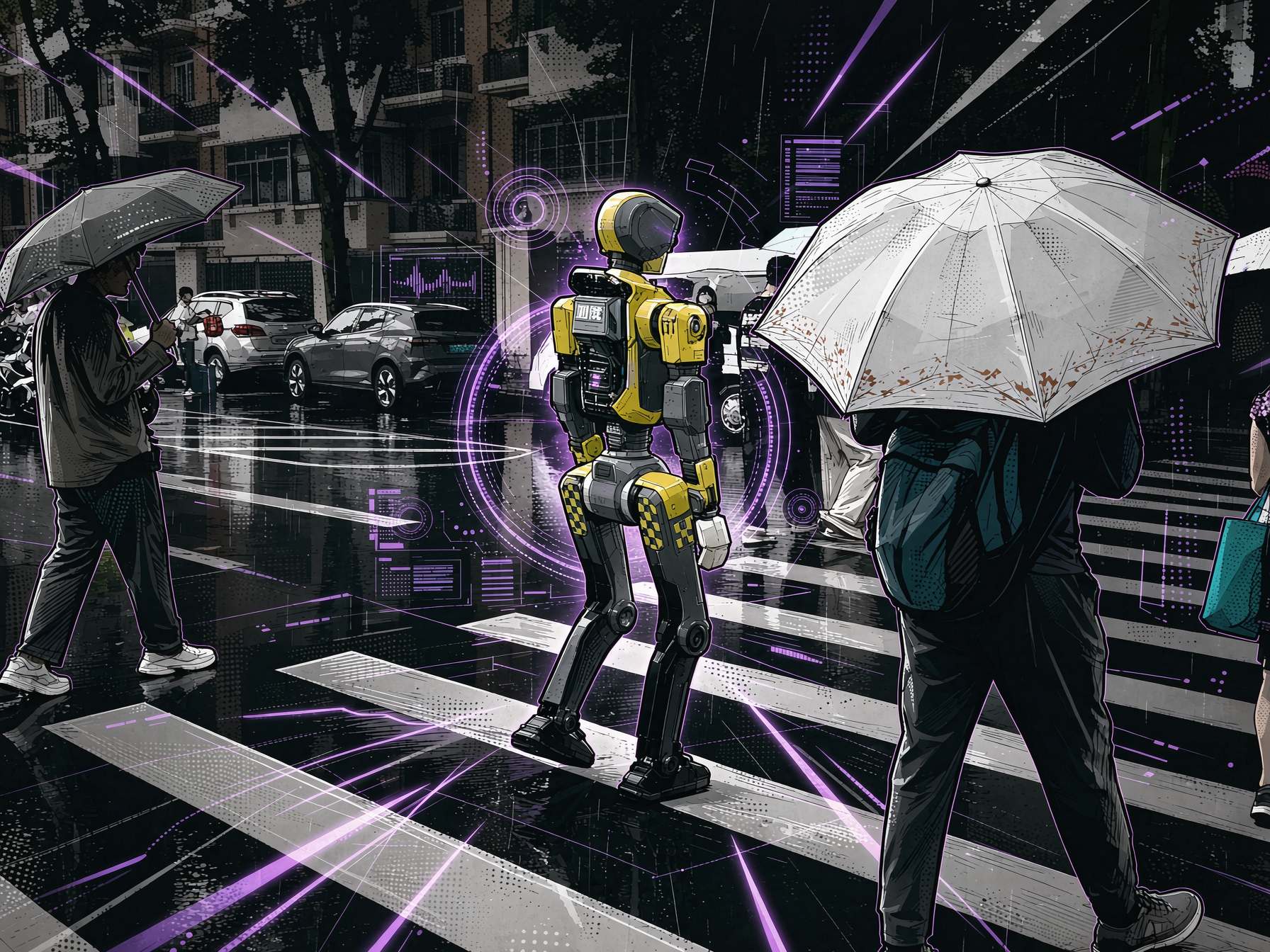
“其他人形机器人等天晴,DR02在西湖区等雨停。”国庆长假,杭州西湖区,雨下得不算大,但没有停的意思。路面泛着水光,游客撑着伞在路口聚集,车流在信号灯下缓慢蠕动,一个身高一米八的特殊执勤者——人形机器人正在雨中站定、抬臂、转身,动作标准而稳定。如果这是任何一个普通公司的宣传片,画面应该在晴天拍摄,人群有序,机器人干净利落,镜头带着柔光。但这是云深处科技主动选择的一个真实测试窗口。
"Other humanoid robots wait for the weather to clear; DR02 waits in Xihu District for the rain to stop." During the National Day holiday, in Xihu District, Hangzhou, the rain was not heavy, but it showed no sign of stopping. The road surface gleamed with water, tourists gathered at intersections holding umbrellas, traffic crept slowly under the traffic lights, and a special one-point-eight-meter-tall duty performer—a humanoid robot—stood firm in the rain, raised its arm, and turned, with standard and stable movements. If this were a promotional video for any ordinary company, the scene should have been shot on a sunny day, with orderly crowds, a clean and efficient robot, and soft-focus lenses. But this was a real testing window actively chosen by Deep Robotics.
不体面的测试
在这个雨水、人流和车流交织的假期里,一批人形机器人DR02被部署到西湖区的重点交通路口和景区周边,干了几件说不上惊天动地的事:在路口值守,用语音引导游客,识别越过停止线的电动车,提醒没戴头盔的骑行者。动作并不酷炫,场景并不体面,甚至连天气都不算配合。但恰恰是这份不体面,值得行业认真对待。因为当大多数公司在讨论人形机器人什么时候能真正干活的时候,云深处已经在用真实场景教机器人怎么干活了。在一个注定混乱、潮湿、无法彩排的真实场景里,在国庆假期这一全年交通压力最极端的窗口之一,云深处让机器人自己摔打一遍,把问题带回来,把产品改上去。
An undignified test
During this holiday, interwoven with rain, crowds, and traffic, a batch of humanoid robots, DR02, was deployed to key traffic intersections and areas around scenic spots in Xihu District, doing a few things that could hardly be called earth-shattering: standing guard at intersections, using voice to guide tourists, identifying electric bikes that crossed the stop line, and reminding cyclists without helmets. The movements were not flashy, the scenes were not dignified, and even the weather was not cooperative. But it is precisely this lack of dignity that the industry should take seriously. Because while most companies are discussing when humanoid robots can truly work, Deep Robotics is already using real scenarios to teach robots how to work. In a real scenario destined to be chaotic, humid, and impossible to rehearse, during the National Day holiday, one of the most extreme windows of traffic pressure in the entire year, Deep Robotics lets the robot take its own knocks, brings the problems back, and improves the product.
测试和演示的区别
云深处没有选择租一个活动场馆,铺上红毯,邀请媒体,拍几段机器人和游客互动的短视频。它选择的,是国庆假期,真实路口,真实雨夜,真实的人流和车流,然后把人形机器人放进去,看它到底行不行。这是两种完全不同性质的行业语言。一个是演示。演示的逻辑是完美的:完美的环境,完美的脚本,完美的镜头,完成一次足以传播的表现即可。另一个是测试。测试的逻辑是残酷的:环境会出错,人会乱走,雨会一直下,地面摩擦系数会因为积水而漂移,游客的提问会超出预设的答案库。前者输出视频,后者输出迭代。
The difference between testing and demonstration
Deep Robotics did not choose to rent an event venue, roll out a red carpet, invite the media, and shoot a few short videos of the robot interacting with tourists. What it chose was the National Day holiday, real intersections, real rainy nights, real crowds and traffic, and then put the humanoid robot into them to see whether it could actually handle it. These are two completely different kinds of industry language. One is demonstration. The logic of demonstration is perfection: a perfect environment, a perfect script, a perfect camera, and one performance good enough to spread. The other is testing. The logic of testing is cruel: the environment will go wrong, people will walk unpredictably, the rain will keep falling, the ground friction coefficient will drift because of standing water, and tourists' questions will exceed the preset answer bank. The former outputs videos; the latter outputs iterations.
从变电站到西湖区路口
云深处的人形机器人此前最值得记录的履历,是在变电站完成作业测试,包括开关操作、线路检测、户外运行等精细任务。而国庆假期把它部署到西湖区的交通路口,看起来像是从B端走到了C端,从工业走到了城市治理。但深挖一层,这其实是同一种能力在不同场景语境下的延展。路口值守需要户外防护、复杂光照下的视觉识别、动态环境中的定位与避障、持续性作业的可靠性。这些能力和变电站巡检的核心诉求高度重合。区别只在于变电站里的障碍物是设备和管线,路口上的障碍物是行人和电动车。场景在变,但底层的能力模块没有变。
From substations to intersections in Xihu District
The most notable previous record of Deep Robotics' humanoid robot was completing operational tests at a substation, including precise tasks such as switch operations, line inspections, and outdoor operation. Deploying it to traffic intersections in Xihu District during the National Day holiday looks like a move from B-end to C-end, from industry to urban governance. But digging one layer deeper, this is actually the extension of the same capability in different scenario contexts. Intersection duty requires outdoor protection, visual recognition under complex lighting, positioning and obstacle avoidance in dynamic environments, and reliability for continuous operation. These capabilities highly overlap with the core demands of substation inspection. The only difference is that the obstacles in a substation are equipment and pipelines, while the obstacles at an intersection are pedestrians and electric bikes. The scenarios change, but the underlying capability modules do not.
湿滑地面的小秘密
这次国庆测试里,有一个很容易被忽略、却最值得细细咀嚼的细节。杭州国庆期间多雨,路面湿滑。对轮式或足式机器人来说,湿滑地面的本质问题,是接地摩擦系数的不确定性。算法在干燥路面上训练得再完美,当轮胎或脚底遇到水面、青苔、被雨水浸透的人行横道线时,运动和路径的关系都会发生微妙偏移。这种偏移不会让机器人立刻摔倒,但它会在持续的作业中累积成误差。比如停下的位置偏差几厘米,转向的时机慢半拍,避障的决策变得保守。这才是真实场景测试真正要抓的东西。不是技术的大秘密,而是物理世界里那些被论文忽略掉的小秘密。IP66的防水等级可以写进参数表,但连续多天在持续降雨、湿度饱和的环境中,整机密封结构是否会出现性能衰减这件事,没有参数,只有实测。
The little secret of slippery ground
In this National Day test, there was a detail that is very easy to overlook but most worth savoring. Hangzhou had a lot of rain during the National Day period, and the roads were slippery. For wheeled or legged robots, the essential problem of slippery ground is the uncertainty of the ground friction coefficient. No matter how perfectly an algorithm is trained on dry pavement, when tires or feet encounter water, moss, or crosswalk lines soaked by rain, the relationship between movement and path will shift subtly. This shift will not make the robot fall immediately, but it will accumulate into errors during continuous operation. For example, the stopping position may deviate by a few centimeters, the timing of turning may be half a beat slow, and obstacle-avoidance decisions may become conservative. This is exactly what real-scenario testing truly needs to capture. Not the great secrets of technology, but the little secrets in the physical world that papers ignore. An IP66 waterproof rating can be written into a specification sheet, but whether the overall sealing structure will show performance degradation after consecutive days in continuous rainfall and saturated humidity—there is no parameter for that, only actual measurement.