
一台能够按照医生指令完成精细操作的瓣膜手术机器人,下一步应该进化成什么样。智程医疗科技(嘉兴)有限公司与苏州沛心科技有限公司给出的共同方向是:以智程医疗的瓣膜机器人为核心载体,融合沛心科技的术前规划、影像智能与专病数据管理能力,让机器人不仅能够准确执行操作,还能够在医生主导下理解手术目标、感知术中状态,并通过学习专家操作形成的模型,为下一步动作提供支持。这一方向背后,是双方对下一代手术机器人的一个核心判断:机器人就是一个综合智能体。
A valve surgery robot capable of performing delicate operations according to a doctor's instructions—what should its next evolutionary step be? The shared direction given by Zhicheng Medical Technology (Jiaxing) Co., Ltd. and Suzhou Peixin Technology Co., Ltd. is: using Zhicheng Medical's valve robot as the core carrier, integrating Peixin Technology's preoperative planning, imaging intelligence, and specialty-disease data management capabilities, so that the robot can not only accurately execute operations, but also understand surgical goals under the doctor's leadership, perceive intraoperative states, and, through models formed by learning expert operations, provide support for the next action. Behind this direction is a core judgment by both parties about the next generation of surgical robots: the robot is a comprehensive intelligent agent.
从机械执行到综合智能体
它不应仅被理解为执行动作的机械设备,而应是将感知、规划、操作策略与物理执行融为一体,并能够利用反馈调整行为的完整系统。这意味着,医疗AI的价值不再只停留在一份分析报告或一项操作建议上,而是以机器人为载体,进一步进入有实时反馈、有安全约束的介入操作流程。AI模型驱动的瓣膜手术机器人,正是具身智能在医疗领域的一条具体发展路径,也是医疗人工智能从辅助分析走向协同执行的创新范式。围绕这一方向,双方将持续推进瓣膜手术机器人与术前规划、术中动态配准的深度整合。
From mechanical execution to a comprehensive intelligent agent
It should not be understood merely as mechanical equipment that executes actions, but as a complete system that integrates perception, planning, operational strategy, and physical execution, and can use feedback to adjust behavior. This means that the value of medical AI no longer stops at an analysis report or an operational suggestion, but, with the robot as its carrier, further enters an interventional operation process with real-time feedback and safety constraints. An AI-model-driven valve surgery robot is precisely a concrete development path for embodied intelligence in the medical field, and also an innovative paradigm for medical artificial intelligence moving from auxiliary analysis to collaborative execution. Around this direction, both parties will continue to advance the deep integration of valve surgery robots with preoperative planning and intraoperative dynamic registration.
智程的瓣膜机器人
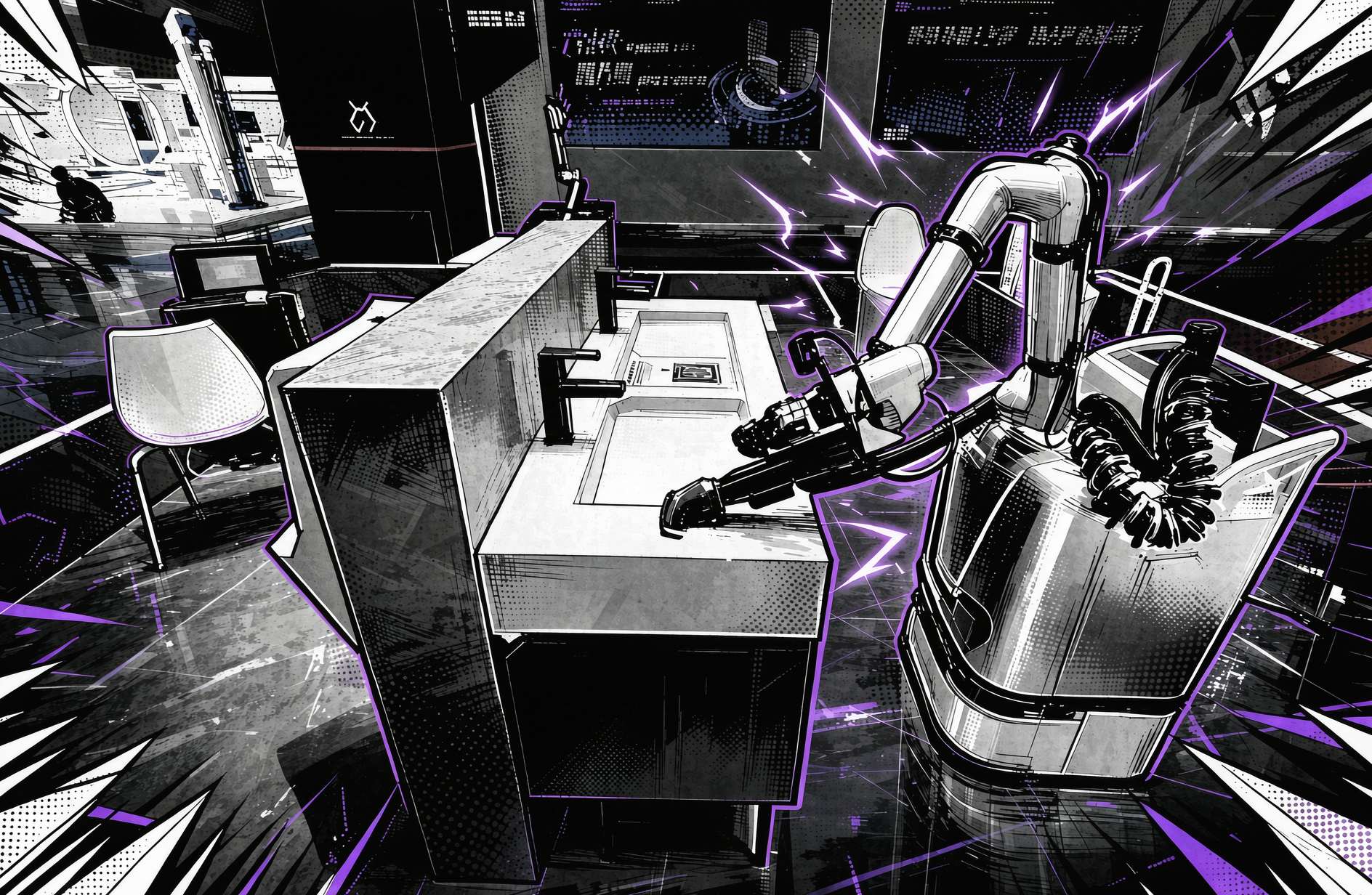
从产品构成看,智程的瓣膜介入机器人采用主从遥操作架构,由主端医生操控台、从端机器人工作站与手术执行器协同组成。据公司产品资料介绍,系统采用轻量化、模块化设计,配合定制耗材盒,并提供实时力反馈与亚毫米级操作控制能力;主端支持触摸屏及DSA影像协同显示,并可切换至手工模式。目前,智程医疗正在推进瓣膜介入机器人的临床验证。据公司提供的最新进展,其第一代瓣膜机器人正在临床中,已获得较好的早期使用反馈。公开资料为这一探索提供了更具体的注脚:2025年TCT大会披露的ReachTactile机器人辅助经导管主动脉瓣置换术早期可行性研究纳入5例患者,均完成30天随访,且未报告主要心脑血管事件。
Zhicheng's valve robot
In terms of product composition, Zhicheng's valve interventional robot adopts a master-slave teleoperation architecture, composed of a master-side doctor console, a slave-side robot workstation, and surgical actuators working in coordination. According to the company's product materials, the system adopts a lightweight, modular design, is paired with customized consumable cartridges, and provides real-time force feedback and sub-millimeter operational control capability; the master side supports touchscreen and DSA image collaborative display, and can switch to manual mode. At present, Zhicheng Medical is advancing clinical validation of its valve interventional robot. According to the latest progress provided by the company, its first-generation valve robot is in clinical use and has received relatively good early user feedback. Public information provides a more specific footnote to this exploration: the early feasibility study of ReachTactile robot-assisted transcatheter aortic valve replacement disclosed at the 2025 TCT conference enrolled 5 patients, all of whom completed 30-day follow-up, and no major cardiovascular and cerebrovascular events were reported.
动态配准是关键
对于下一代瓣膜机器人,术前规划可以回答目标在哪里、需要注意什么,却不能单独回答器械此刻在哪里、与目标的关系发生了什么变化。患者的术前CT模型,与术中持续变化的真实场景并不天然重合。心脏搏动、呼吸运动以及器械操作,都可能改变影像中观察到的空间关系。对于希望利用规划指导操作的机器人而言,只有静态模型还不够,还需要不断更新对当前状态的判断。这正是沛心科技正在研发术中动态配准的核心原因,也是智程机器人向综合智能体演进需要补齐的关键能力。沿着双方选择的技术路线,动态配准需要把术前的三维解剖与规划信息,同术中的DSA影像持续对应起来,并进一步建立影像坐标与机器人操作坐标之间的可靠映射。
Dynamic registration is key
For the next-generation valve robot, preoperative planning can answer where the target is and what needs attention, but it cannot by itself answer where the instrument is at this moment and what has changed in its relationship to the target. The patient's preoperative CT model does not naturally coincide with the continuously changing real scene during surgery. Cardiac pulsation, respiratory motion, and instrument manipulation can all change the spatial relationships observed in imaging. For a robot that hopes to use planning to guide operations, a static model alone is not enough; it also needs to continuously update its judgment of the current state. This is precisely the core reason why Peixin Technology is developing intraoperative dynamic registration, and also the key capability that must be filled in for Zhicheng's robot to evolve into a comprehensive intelligent agent. Along the technical route chosen by both parties, dynamic registration needs to continuously correspond preoperative three-dimensional anatomical and planning information with intraoperative DSA images, and further establish a reliable mapping between image coordinates and robot operation coordinates.
AI的蓄水池
如果术前规划提供地图、动态配准提供导航,那么支撑模型训练与智能体决策的重要基座,就是高质量的数据。沛心科技的结构性心脏病专病数据管理系统,正是针对这一难点提供的系统性解决方案。它的价值不是再增加一个存放病例的工具,而是将分散的专病资料纳入统一、持续的数据管理框架。这也是将专病数据系统视为AI蓄水池基础设施的意义:一端持续汇聚和组织临床信息,另一端为模型训练与智能体应用提供可用的数据基础。机器人所支持的手术决策,不能只以某一时刻的术中影像或一段操作轨迹为依据,而应建立在贯通术前、术中与术后的全周期证据之上。双方提出的CardioAgent联合构想,正是以智程的机器人平台为核心载体,将沛心的专病数据底座、规划导航与AI能力逐步融合,形成面向瓣膜介入任务的综合智能体。
AI's reservoir
If preoperative planning provides the map and dynamic registration provides navigation, then the important foundation supporting model training and intelligent-agent decision-making is high-quality data. Peixin Technology's structural heart disease specialty-disease data management system is precisely a systematic solution provided for this difficulty. Its value is not to add yet another tool for storing cases, but to incorporate scattered specialty-disease materials into a unified and continuously managed data framework. This is also the significance of treating a specialty-disease data system as AI reservoir infrastructure: one end continuously aggregates and organizes clinical information, while the other end provides a usable data foundation for model training and intelligent-agent applications. The surgical decisions supported by the robot cannot be based only on intraoperative imaging at a certain moment or a segment of an operation trajectory, but should be built on full-cycle evidence connecting the preoperative, intraoperative, and postoperative periods. The joint CardioAgent concept proposed by both parties precisely takes Zhicheng's robot platform as the core carrier and gradually integrates Peixin's specialty-disease data foundation, planning and navigation, and AI capabilities to form a comprehensive intelligent agent oriented toward valve intervention tasks.