

机器人这两年越来越火了,但大部分机器人的价格都还没有低到让普通人人手一台的程度。目前来说,哪怕市场出现了启元这样的个人机器人玩家,但一台功能齐全、结构完整的人形机器人,价格至少要数万元,更不用说那些十几万几十万的了。最近,加州大学洛杉矶分校的研究团队给出了一份特别的方案,一台重1.8公斤的双足机器人,物料成本只要大约400美元,约合人民币2677元。最近,一篇论文出现在arXiv上,它介绍了一款名为PhoneBot的机器人,论文作者来自UCLA机械与航空航天工程系的RoMeLa实验室。
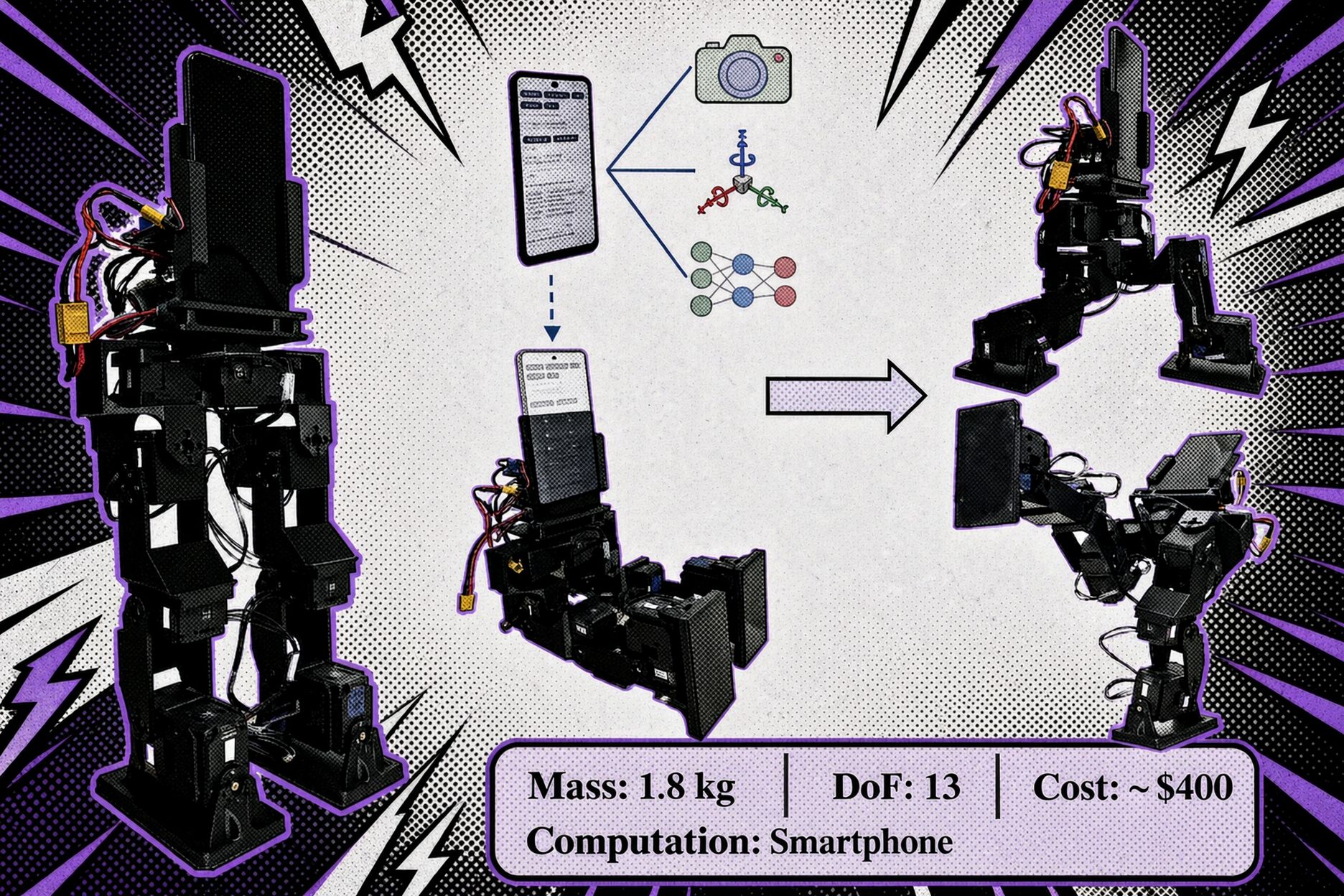
Robots have become increasingly popular these past two years, but most robots' prices have not yet dropped low enough for ordinary people to own one each. Currently, even with personal robot players like Qiyuan entering the market, a fully functional, structurally complete humanoid robot costs at least tens of thousands of yuan, let alone those costing hundreds of thousands or millions. Recently, a research team from UCLA offered a special solution—a 1.8-kilogram bipedal robot with material costs of only about $400, roughly 2,677 yuan. Recently, a paper appeared on arXiv introducing a robot called PhoneBot, with authors from the RoMeLa Lab in UCLA's Department of Mechanical and Aerospace Engineering.
具体参数方面,PhoneBot整机高483毫米、重1.8公斤,13个自由度,每个关节用一颗单价23.9美元的舵机。最关键的是,它是靠智能手机来驱动的。具体来说,手机被固定在机器人躯干位置,同时充当机器人的传感器套件、板载计算机和交互界面。据介绍,这款机器人拥有的能力包括行走、起立、跟随人、拍摄、对话交互等。用手机驱动机器人,这听起来很不可思议,但PhoneBot确实做到了。智能手机作为当下最流行的消费电子设备,它的集成度极高,内置了摄像头、SoC、屏幕、WiFi、电池等,而这些部件都可以为机器人所用,并成为它的能力的一部分。
On specific parameters, PhoneBot stands 483 mm tall, weighs 1.8 kg, has 13 degrees of freedom, with each joint using a servo priced at $23.9. Most critically, it is driven by a smartphone. Specifically, the phone is fixed at the robot's torso position, simultaneously serving as the robot's sensor suite, onboard computer, and interaction interface. According to the introduction, this robot's capabilities include walking, standing up, following people, photographing, and conversational interaction. Using a phone to drive a robot sounds incredible, but PhoneBot确实 achieved it. Smartphones, as today's most popular consumer electronics, have extremely high integration, with built-in cameras, SoCs, screens, WiFi, batteries—all of which can be used by the robot and become part of its capabilities.
配备了手机的PhoneBot,能利用摄像头来进行图像感知,能用芯片来计算和推理,通过网络来获取资料和云端算力。当然,开头说到的400美元物料成本是不包含手机的,但PhoneBot测试时用的都是老款手机,包括moto G 2025、三星Galaxy A15等,二手价基本都不超过100美元。所以,即便把手机的硬件成本算上,PhoneBot总的物料成本也低于500美元,换算成人民币只要3000多元。另外,用手机驱动机器人的尝试,很早就开始了。早在2021年,就出现过一个名为OpenBot的项目,它用一台普通安卓手机支撑四轮机器人的跟随与导航。PhoneBot则沿用这个思路推进到双足机器人上。其实,它的难度比四轮要大很多,双足机器人站立和做动作时要靠实时平衡。而要实现这点,不是简单接入一部手机就能做到的。
Equipped with a phone, PhoneBot can use the camera for image perception, use the chip for computation and reasoning, and access information and cloud compute through the network. Of course, the $400 material cost mentioned at the beginning does not include the phone, but PhoneBot testing used older phones including moto G 2025 and Samsung Galaxy A15, with second-hand prices basically not exceeding $100. So even including the phone's hardware cost, PhoneBot's total material cost is below $500, converting to just over 3,000 yuan. Additionally, attempts to use phones to drive robots began early. As early as 2021, a project called OpenBot appeared, using an ordinary Android phone to support four-wheeled robot following and navigation. PhoneBot follows this idea into bipedal robots. In fact, its difficulty is much greater than four-wheeled—bipedal robots rely on real-time balance when standing and moving. Achieving this is not simply a matter of connecting a phone.
PhoneBot的方案就是,手机装在躯干上,机器人的眼睛、耳朵和脑子都由它来当。团队把它的活儿分成三块,一块负责运动,一块负责图像识别,一块负责说话。运动这块是最关键的。手机上的安卓应用一边读手机里的陀螺仪和加速度计,一边读腿上十三个电机的当前角度,再结合用户下达的指令,凑成一份设备当下状况的信息。手机里还装着一个事先练好的小模型,通过它拿到信息后就立刻算出每条腿该摆到什么位置,再通过Wi-Fi把指令发下去,由一块很小的转换板转给电机。机器人走路、从地上爬起来、调整朝向,都是通过这套模式来实现。
PhoneBot's solution is: the phone is mounted on the torso, and it serves as the robot's eyes, ears, and brain. The team divided its work into three parts: one for movement, one for image recognition, one for speech. The movement part is the most critical. The Android app on the phone reads the phone's gyroscope and accelerometer while reading the current angles of thirteen motors on the legs, then combines with user commands to assemble information about the device's current state. A pre-trained small model is also installed on the phone; upon receiving information, it immediately calculates where each leg should be positioned, then sends commands via Wi-Fi to a small conversion board that relays to the motors. The robot walking, getting up from the ground, and adjusting orientation are all achieved through this pattern.
图像识别这部分全部在手机里完成。手机后置摄像头负责认人、认物体,再配合朝向指令,机器人就能跟着人走或者把视线转向指定方向。定位也交给它,手机靠摄像头加上陀螺仪的数据算出自己站在哪儿,不需要另外配备一个定位设备。说话这部分要更复杂一些。手机负责录音和播放,但比较耗费算力的语音转文字和大模型推理则还要借助放在旁边的一台笔记本,结果传回手机后再播放出来。至于怎么学会走路,PhoneBot团队的办法是先在电脑里训练。他们先把机器人上的每颗电机的真实力量算清楚,再让机器人在模拟环境里反复试错,摔倒重来直到走稳。团队训练时还把机器人的左腿的动作镜像成右腿的,左右一起练。
The image recognition part is entirely completed within the phone. The phone's rear camera recognizes people and objects; combined with orientation commands, the robot can follow people or turn its gaze to a specified direction. Positioning is also handled by it—the phone uses the camera plus gyroscope data to calculate where it is standing, without needing a separate positioning device. The speech part is more complex. The phone handles recording and playback, but the more compute-intensive speech-to-text and large model reasoning still rely on a nearby laptop, with results sent back to the phone for playback. As for learning to walk, the PhoneBot team's approach was to first train in a computer. They first calculated the real force of each motor on the robot, then let the robot repeatedly trial-and-error in a simulated environment, falling and restarting until it walked steadily. During training, the team also mirrored the robot's left leg movements to the right leg, training both sides together.
根据该团队提供的数据,手机读陀螺仪数据时CPU的占用率在8.5%到13.4%之间,算走路姿势时占用率为6.3%到10.3%,识别人和物体时占用率为15.6%到17.9%,最消耗硬件资源的定位占用率为25%到34.3%。这项目测试说明,PhoneBot不挑手机,机器人用的就是手机这些年攒下的摄像头、陀螺仪、算力和系统生态。PhoneBot成本低,说白了就是把智能手机的硬件资源都榨干了,有啥用啥,能省则省。当然,还有很关键的一点,这个机器人是没有手臂的,说是机器人,最核心的运动能力就是走路和做动作的两条腿。而且,它的体积很小,也没有负重、爬楼梯等复杂的任务。说到底,它就是一个实验室里的测试设备。
According to data provided by the team, CPU usage when the phone reads gyroscope data is between 8.5% and 13.4%; calculating walking posture 6.3% to 10.3%; recognizing people and objects 15.6% to 17.9%; and positioning, the most hardware-intensive, 25% to 34.3%. This project test shows PhoneBot is not picky about phones—the robot uses the cameras, gyroscopes, compute, and system ecosystem phones have accumulated over the years. PhoneBot's low cost, simply put, is squeezing all hardware resources out of the smartphone, using whatever is available and saving wherever possible. Of course, one key point: this robot has no arms. As a robot, its core motion capability is the two legs for walking and moving. Moreover, it is very small, without complex tasks like carrying loads or climbing stairs. Ultimately, it is a laboratory test device.
智能手机可能是更新迭代周期最短的消费电子产品,全球每年被淘汰的手机数以亿计。这些设备里集成了摄像头、屏幕、芯片以及各类传感器,大部分都功能完好,只是因为不够新而被淘汰。PhoneBot的出现,给了二手手机一个新的出路,这些被闲置的算力和传感器,可以用在这类小型机器人身上。它还提出了一个新思路,机器人的大脑可以当耗材,本体才是长期部件。手机两三年一换,换下来的机型正好可以塞进去。当然,这个方案的缺点也很明显。手机本身不是为机器人设计的,散热、供电等都要重新处理,不同型号的手机的配置存在差异,会直接影响机器人运行效果。而且,二手设备的质量和稳定性缺乏保障。还有一点很关键,手机终究无法提供强劲的算力。
Smartphones may be the consumer electronics with the shortest iteration cycle, with hundreds of millions discarded globally each year. These devices integrate cameras, screens, chips, and various sensors, most still fully functional, eliminated only because they are not new enough. PhoneBot's emergence gives second-hand phones a new outlet—this idle compute and sensors can be used in such small robots. It also proposes a new idea: the robot's brain can be a consumable, while the body is the long-term component. Phones are replaced every two or three years, and the retired models can be inserted. Of course, this solution's drawbacks are obvious. Phones are not designed for robots; heat dissipation and power supply must be re-handled. Different phone models have configuration differences that directly affect robot operation. Moreover, second-hand device quality and stability lack guarantees. One more key point: phones ultimately cannot provide strong compute.
但不管怎么说,PhoneBot证明了手机驱动机器人这件事能够成立,也就提供了一套可供行业借鉴的低成本方案。对于整个机器人行业而言,PhoneBot的意义或许并不在于它能立刻走向市场成为消费级爆款,而在于它打破了双足机器人的硬件入门门槛。长期以来,仿生机器人研发的高昂成本,将无数想要入局的开发者、高校学生团队和初创公司挡在了门外。PhoneBot这种廉价躯干加二手手机大脑的架构,实际上扮演了机器人领域树莓派的角色,有希望催生出一个庞大的平民化开发者生态,让更多人有机会开发并训练属于自己的双足机器人。
But regardless, PhoneBot proves that phone-driven robots are feasible, providing a low-cost solution the industry can reference. For the entire robotics industry, PhoneBot's significance may not lie in immediately becoming a consumer hit but in breaking the hardware entry barrier for bipedal robots. For a long time, the high cost of biomimetic robot R&D has kept countless developers, university student teams, and startups out. PhoneBot's "cheap body + second-hand phone brain" architecture effectively plays the role of Raspberry Pi in robotics,有望 spawning a massive democratized developer ecosystem, letting more people develop and train their own bipedal robots.


