
10月20日上午,一条20米长的跑道上进行了几场特别的赛跑。一侧是马拉松运动员萨巴斯蒂安·萨维与越野跑运动员赵家驹,另一侧是荣耀自研人形机器人闪电。两位人类选手平时比拼的对手是人,这一次换成了一台机器人。这场首次线下同框由荣耀于10月17日官宣,方式为同台竞速互动。当天8点30分,荣耀机器人专家李正介绍嘉宾与机器人情况,并向两位运动员请教长短跑的步频、步幅等技巧;8点50分起进行多轮20米竞速,萨维、赵家驹先单独迎战闪电,再共同出战,高通高管、现场KOL与骁友陆续加入;9点40分由凤凰体育主持快问快答,9点50分结束。
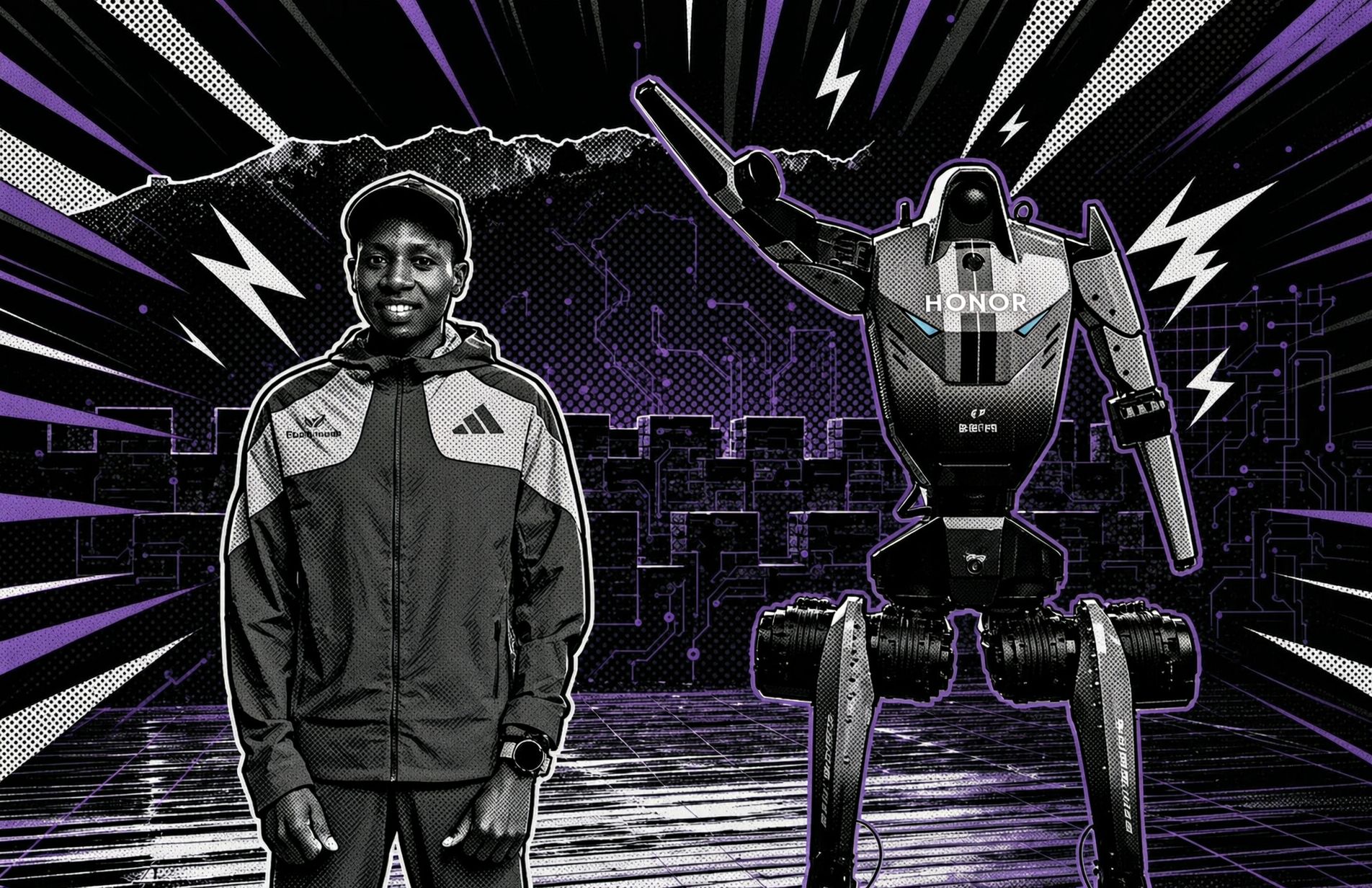
On the morning of October 20, several special races were held on a 20-meter track. On one side were marathon runner Sabastian Sawe and trail runner Zhao Jiaju; on the other was Honor's self-developed humanoid robot Lightning. The two human athletes usually compete against people; this time it was against a robot. This first offline co-appearance was officially announced by Honor on October 17 as a same-stage racing interaction. At 8:30 that day, Honor robotics expert Li Zheng introduced the guests and robot and consulted the two athletes on sprint and distance running techniques including cadence and stride length; from 8:50, multiple rounds of 20-meter races took place—Sawe and Zhao Jiaju first faced Lightning individually, then together, with Qualcomm executives, on-site KOLs, and fans joining in; at 9:40 Phoenix Sports hosted a quick Q&A, ending at 9:50.
资料显示,萨维是人类历史上首位在马拉松正赛中跑进2小时的运动员,全程42.195公里折算下来,平均每公里配速在2分50秒以内。赵家驹在2026年夺得意大利巨人之旅330公里组别冠军,是该组别首位中国籍亚洲冠军。闪电则在4月19日的北京亦庄人形机器人半程马拉松中,以50分26秒的净用时夺冠。闪电身高169厘米,产品型号为HONOR Robotics D1,具备自主感知导航能力,搭载自研高动态运动系统与一体化关节模组。其0.95米有效腿长参考了长跑运动员的身体结构,为备战8月第二届世界人形机器人运动会,腿部加长10厘米至1.05米,并采用轻量化拓扑结构。100米竞速依靠髋部摄像头完成纯视觉识别,400米项目增加头部雷达辅助规划路线。散热采用液冷方案,132款金属结构件由蓝思科技提供。
Records show Sawe is the first human in history to run a marathon under 2 hours in an official race; over 42.195 km, his average pace was within 2 minutes 50 seconds per kilometer. Zhao Jiaju won the 330 km category of Italy's Tor des Géants in 2026, the first Chinese and Asian champion in that category. Lightning won the April 19 Beijing Yizhuang Humanoid Robot Half Marathon with a net time of 50 minutes 26 seconds. Lightning stands 169 cm tall, model HONOR Robotics D1, with autonomous perception and navigation capability, carrying a self-developed high-dynamic motion system and integrated joint modules. Its 0.95-meter effective leg length references distance runners' body structure; to prepare for the August Second World Humanoid Robot Games, legs were lengthened 10 cm to 1.05 meters with lightweight topological structure. The 100-meter sprint relies on hip cameras for pure visual recognition; the 400-meter event adds head radar to assist route planning. Cooling uses liquid cooling; 132 metal structural parts are supplied by Lens Technology.
值得关注的是,2025年2月,荣耀成立人形机器人部门,团队超200人,分布在北京、上海、深圳三地,覆盖整机、硬件、运控、感知、具身AI、测试等环节。同年3月发布阿尔法战略,计划5年投入100亿美元建设全场景AI终端生态;2025年11月披露研发团队占比超70%、累计AI专利达2100项。2026年3月的MWC大会上,荣耀发布机器人手机Robot Phone与消费级具身智能人形机器人,成为全球首家入局消费级人形机器人的手机品牌,并提出增强人类智能的AHI理念。机器人业务聚焦消费市场,规划商场、工厂、家庭三大场景,小尺寸的元气仔将用于门店智慧零售。
Notably, in February 2025 Honor established a humanoid robot department with over 200 team members across Beijing, Shanghai, and Shenzhen, covering complete machines, hardware, motion control, perception, embodied AI, and testing. In March the same year it released the Alpha Strategy, planning $10 billion investment over 5 years to build a full-scenario AI terminal ecosystem; in November 2025 it disclosed R&D team share exceeding 70% and cumulative AI patents reaching 2,100. At MWC in March 2026, Honor released the Robot Phone and consumer-grade embodied intelligence humanoid robot, becoming the world's first phone brand to enter consumer humanoid robots, and proposed the AHI concept of augmenting human intelligence. The robot business focuses on consumer markets, planning three major scenarios—malls, factories, and homes; the small-size Yuanqi Zai will be used for smart retail in stores.
这场20米竞速的象征意义大于实际意义。萨维是人类马拉松破2的第一人,赵家驹是330公里越野的亚洲冠军,两个人的耐力在人类里属于顶尖水平。但20米竞速比的是短距离爆发,不是耐力。机器人闪电的优势在于起步快、步频稳定、不受疲劳影响,人类选手的优势在于爆发力和临场调整能力。20米这个距离,恰好放大了机器人起步和节奏稳定的优势,也放大了人类在短距离上启动和加速的局限。这场比赛的设计本身就在制造话题,而不是在做一场公平的体能对比。
This 20-meter race's symbolic meaning outweighs its practical meaning. Sawe is the first human to break 2 hours in the marathon; Zhao Jiaju is the 330-km trail running Asian champion—both have top-tier human endurance. But 20-meter racing tests short-distance explosiveness, not endurance. Robot Lightning's advantage lies in fast starts, stable cadence, and no fatigue; human athletes' advantage lies in explosive power and on-the-spot adjustment. The 20-meter distance precisely amplifies the robot's starting and rhythm stability advantages while amplifying humans' limitations in short-distance launch and acceleration. The race design itself manufactures话题 rather than conducting a fair physical fitness comparison.
荣耀做这场活动的目的,和前面讨论的雨果在东京游乐园靠拥抱跳舞吸引游客、翠翠在边城当导游、宇树科技在春晚上表演是同一个逻辑,都是把机器人推到公众面前,制造话题和认知。但荣耀和这些案例的区别在于,它是一家手机品牌,人形机器人业务聚焦消费市场,规划商场、工厂、家庭三大场景。前面讨论过万元级人形机器人进入消费市场,也讨论过启元机器人发布Q1、T1两款个人机器人、定价19999元起。荣耀这次让机器人跟人类顶尖运动员赛跑,本质上是在为它的消费级人形机器人做品牌预热。机器人能不能跑赢人类不是重点,重点是让公众记住荣耀也做人形机器人,而且做得还不错。
Honor's purpose in holding this event follows the same logic as the previously discussed Hugo attracting tourists with hugs and dancing at a Tokyo amusement park, Cuicui serving as a guide in Border Town, and Unitree performing at the Spring Festival Gala—all push robots before the public to create话题 and awareness. But Honor differs from these cases in being a phone brand, with humanoid robot business focused on consumer markets and planning three major scenarios—malls, factories, and homes. Earlier we discussed ten-thousand-yuan humanoid robots entering the consumer market, and Qiyuan Robotics launching Q1 and T1 personal robots priced from 19,999 yuan. Honor having its robot race against top human athletes is essentially brand预热 for its consumer humanoid robots. Whether the robot can beat humans is not the point; the point is letting the public remember Honor also makes humanoid robots—and makes them well.